Your First Pool in Brevard: The Weekly Checklist
A pool runs on a short list of habits, and in Brevard County the habits matter a little more than most places.
October 27, 2026 · 4 min read
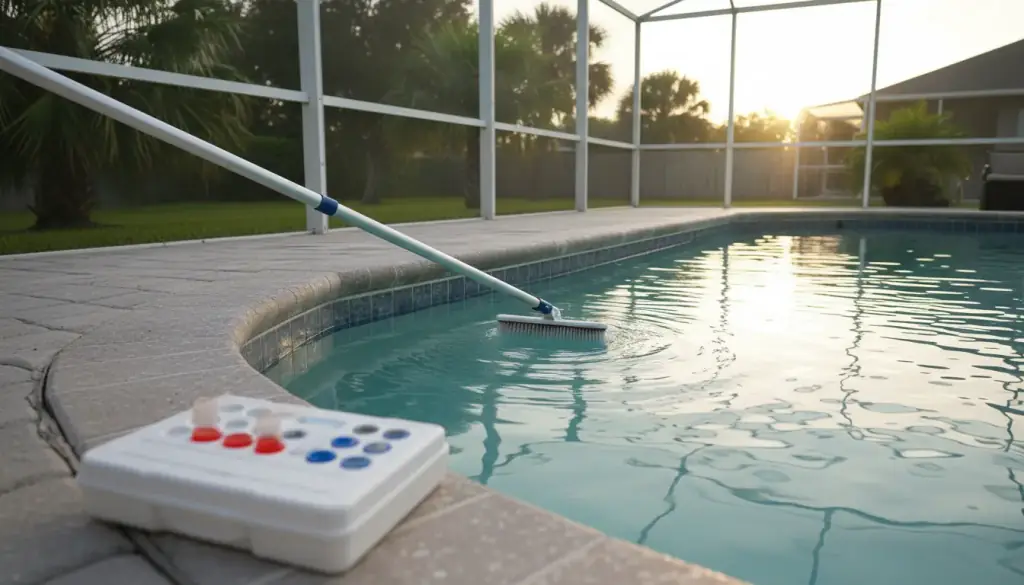
You closed on a house in Viera or Suntree, and the pool came with it. The listing made it look easy. Then a week of July rain goes by, the water picks up a green tinge, and you realize nobody handed you a manual. Good news: a pool runs on a short list of habits. In Brevard County those habits matter a little more than elsewhere, because the sun is strong, the afternoon storms are frequent, and the water never gets a winter rest.
Here's the weekly routine we walk new owners through at the store. It takes less time than most people expect once it becomes a habit.
Test the water every week
If you only do one thing, do this. Use a test kit or test strips, and check the basics: chlorine, pH, alkalinity and stabilizer. Pick the same day each week so you can see trends. A reading that drifts a little each week is easy to correct. A reading you ignored for a month is a green pool.
Write the numbers down on a card or in your phone. The pattern tells you more than any single test, and it gives us something real to work with if you ever call about a problem. Florida sun burns chlorine off fast, and a hard summer thunderstorm dilutes everything at once, so retest after a big rain even if it isn't your usual day. We won't hand you one magic number to memorize here, because the right targets depend on your pool's surface, your sanitizer and your equipment. Ask us, and we'll show you what to aim for on your pool.
Add chemicals in small, careful steps
Chemicals fix what the test shows. Add what the test calls for, not what feels like enough. Pour slowly with the pump running so the water circulates. Never mix products in a bucket, never add one chemical on top of another, and read the label every time. Store everything dry, closed and well out of reach of kids and pets. If a bottle's directions and our advice ever seem to differ, bring the bottle in and we'll sort it out together.
Resist the urge to dump in extra to catch up. Overdoing it creates a second problem, and fixing that takes longer than the first one did. Small and steady beats big and rare.
Check the water level often
The water line should sit around the middle of the skimmer opening. If it drops too low, the skimmer pulls in air, and that is hard on the pump. If it climbs too high, the skimmer can't do its job pulling debris off the surface. Brevard's rainy season can raise the level in a single afternoon, and the dry spring months pull it down through evaporation. Glance at the skimmer when you step out onto the lanai with your coffee. It takes five seconds.
Remove debris before it sinks
Palm fronds, oak leaves, flower petals and the occasional lizard all end up in the water. Skim the surface with a leaf net, then empty the skimmer basket and the pump basket. Debris left sitting turns into sediment, and sediment feeds algae and can stain the surface.
Brush the walls and steps too. Even when the water looks clear, a quick pass with the brush keeps algae from getting a grip in the corners and behind ladders, where circulation is weakest.
Keep the filter and pump clean
Clean filters and pumps are the key to keeping a pool in the swim. A clogged filter means weak circulation, and weak circulation means cloudy water no matter how many chemicals you pour in. Look at the pressure gauge right after the filter has been cleaned and note the number. When the gauge climbs well above that, the filter needs attention. Depending on the type, that means a backwash or pulling the cartridge and rinsing it. If you're not sure what kind of filter you have, ask us. We can usually tell from the model.
Keep the water moving
Still water goes green. A blocked drain, or a pool with the water too low, can cause real trouble. Make sure the pump runs long enough each day to turn the water over. How long depends on your pool size and your pump, and in the summer you'll likely want more hours than in January. Check that the return jets are pushing water, and that nothing is clogging the suction side.
The weekly list at a glance
- Test the water, and write the numbers down.
- Add chemicals only as the test calls for.
- Check the water level at the skimmer.
- Skim, empty the baskets, brush and vacuum.
- Check the filter pressure and clean the filter when it's due.
- Confirm the pump is running and the water is moving.
Learn on the job
If all of this feels like a lot, that's normal. Our weekly maintenance program includes a Learn On The Job option built for exactly this moment. If you just moved into a home with your first pool, we'll show you the ropes: cleaning techniques, water testing and chemicals, and pool maintenance safety. You get hands-on practice with a family owned Melbourne company that has been at this since 1990.
Call (321) 255-0506 or stop by the store at 4100 N. Wickham Road, #122, in Melbourne. We're open Monday through Friday 9 to 6, Saturday 9 to 5, and closed Sunday. And if you'd rather hand the weekly routine off completely, ask us about the weekly pool maintenance program at /services/weekly-pool-maintenance.
Aqua-Rite Pools & More, (321) 255-0506
Call (321) 255-0506More articles
Why Your Gas Pool Heater Won't Fire, and What to Check Before You Call
Most no-heat calls come down to a short list of causes, and a few of them you can rule out yourself in ten minutes.
Pump and Filter Warning Signs Brevard Pool Owners Shouldn't Ignore
Your equipment pad talks to you long before something fails, if you know what to listen and look for.