Pump and Filter Warning Signs Brevard Pool Owners Shouldn't Ignore
Your equipment pad talks to you long before something fails, if you know what to listen and look for.
October 27, 2026 · 4 min read
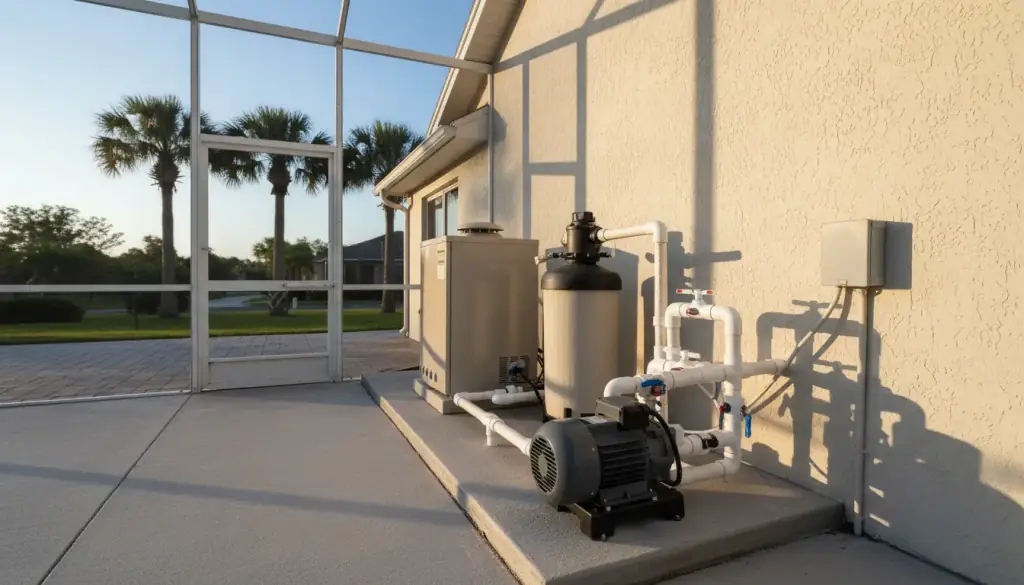
The pump and filter are the heart of your pool. Together they pull water from the pool, push it through the filter and send it back clean. When they work, you don't think about them. When they start to struggle, they usually give you warnings first. In Brevard County, where equipment lives outside in humidity, summer storms and long runtime hours, those warnings are worth learning.
Sign one: the pressure gauge keeps climbing
Your filter has a pressure gauge. Right after a clean, note where it sits. Over the next weeks it will creep up as the filter loads with debris. That's normal. What isn't normal is a gauge that climbs fast, or one that stays high right after you've cleaned the filter. High pressure means water is struggling to get through. The cause might be a dirty cartridge, worn filter media, a blocked return line or a closed valve. If the pressure is low and flow looks weak, the problem may be on the suction side instead, such as a clogged basket or an air leak. Either way, the number is telling you something, so write it down.
Sign two: a new noise
A healthy pump hums. If it starts grinding or screeching, that often points to worn bearings, and bearings don't fix themselves. A rattle can mean debris has made its way into the impeller. A gurgling or sputtering sound usually means the pump is pulling air. Learn what your pump sounds like on a good day, and you'll notice the change quickly. A pump that runs loud for weeks can fail suddenly, usually on a hot afternoon when you need it most.
Sign three: air bubbles in the water
Look at the clear lid on your pump basket and at the water coming out of the return jets. A steady stream of bubbles means air is getting into the system somewhere. Common culprits include a worn lid o-ring, a loose fitting on the suction side, or a low water level at the skimmer. Air makes the pump work harder, reduces flow, and can cause it to lose prime. That's why our weekly service includes inspecting and lubricating o-rings. A small rubber ring is a cheap part to look after and an annoying one to ignore.
Sign four: a leak, even a small one
Walk the equipment pad and look at the joints. A damp patch or slow drip around a PVC joint, a union or the pump itself is worth attention. Pump leaks often start at a shaft seal, and a drip underneath the pump that appears when it runs is a classic sign. A leaking PVC joint is one of the most common repairs we see, and it's usually easy to deal with when it's caught early. Left alone, a leak wastes water, can pull air into the system, and can wash out the ground under the pad.
Sign five: the water is cloudy no matter what you do
If you're testing weekly and keeping the water balanced, and it still looks hazy, circulation or filtration is the first suspect. Maybe the pump isn't moving enough water, or the filter isn't catching what it should. More chemicals won't solve a filtration problem. That's a good moment to call the store and tell us what the gauge and the pump have been doing.
Sign six: it's hot, it trips, or it stops
A pump motor that's too hot to touch, that trips the breaker, or that shuts itself off needs a professional. Don't keep resetting it. Repeated trips are the system telling you there's a problem with the motor, the wiring or the load it's under, and electricity near water is not a place for guesswork.
Keep the pad in good shape
- Keep palm fronds, leaves and mulch from piling up around the motor.
- Leave space around the pump so air can reach it and cool it.
- Empty the pump basket and skimmer basket on schedule.
- Watch the gauge and note the number after every filter clean.
- Look for drips, damp spots and white crust at joints.
- Listen for changes in sound whenever you walk past.
Repair or replace?
Sometimes the answer is a seal, a basket or an o-ring. Sometimes it's a motor, and sometimes it's a full system replacement with the latest technology. We handle everything from a leaky PVC joint to a complete system replacement. We'll tell you plainly which one your equipment needs, and we'll explain why. An older pump that keeps needing small repairs may be better replaced, and a newer one with a single failed part may be worth keeping. The right answer depends on what we find when we look at it.
Aqua-Rite has been family owned in Melbourne since 1990, and our repair techs keep attending training seminars and classes to stay current. If your pump or filter is giving you any of the signs above, call (321) 255-0506 or come see us at 4100 N. Wickham Road, #122. You can read more about our work at /services/pool-repairs, and if you need a part or a replacement, the shelves at /services/pool-supply-store are stocked with pumps, filters and parts from name brand suppliers.
Aqua-Rite Pools & More, (321) 255-0506
Call (321) 255-0506More articles
Your First Pool in Brevard: The Weekly Checklist
A pool runs on a short list of habits, and in Brevard County the habits matter a little more than most places.
Why Your Gas Pool Heater Won't Fire, and What to Check Before You Call
Most no-heat calls come down to a short list of causes, and a few of them you can rule out yourself in ten minutes.